Four Things Resilient Leaders Never Stop Doing

Most leadership conversations about resilience sound like motivational posters. Stay positive. Push through. Bounce back.
That’s not resilience. That’s denial with better branding.
Real resilience — the kind that sustains a CEO through a market shift, a failed hire, or a quarter that didn’t land — isn’t about toughness. It’s about capability. Leaders who endure aren’t just mentally strong. They’ve built habits and systems that keep them leading well when conditions get hard.
After years of coaching CEOs and founders through exactly these moments, I’ve seen a pattern. The most resilient leaders consistently do four things.
I call it the CORE Framework.
The CORE Framework for Resilient Leadership
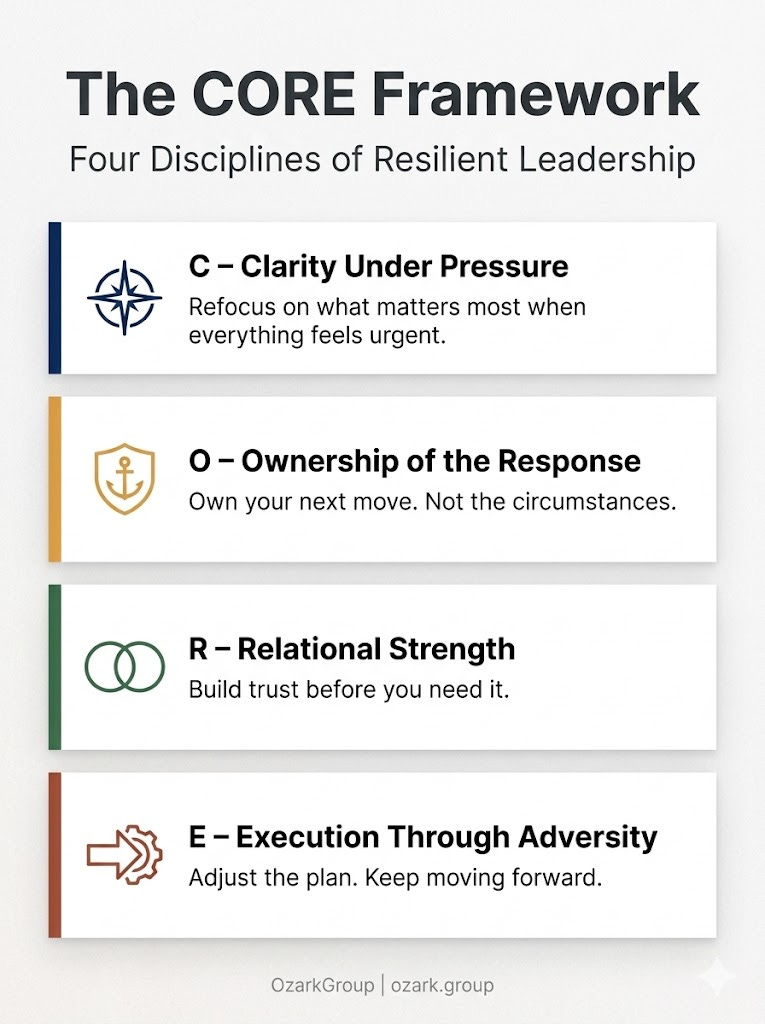
Clarity Under Pressure
When everything feels urgent, most leaders speed up. Resilient leaders slow down — just long enough to ask: What actually matters right now?
Pressure doesn’t create confusion.
It reveals a lack of clarity that was already there.
The leaders who navigate hard seasons well are the ones who can separate signal from noise and refocus their team on the few things that will move the business forward.
Ask yourself: If I could only focus on one thing this week, what would have the most impact?
Ownership of the Response
You don’t control what happens to your business.
You control what you do next.
This is the stewardship mindset. Resilient leaders don’t waste energy assigning blame or replaying what went wrong. They take full ownership of their response — the decision, the communication, the next step. That posture is contagious. When a leader owns the response, the entire team moves faster.
Ask yourself: Am I spending more energy on what happened or on what I’m going to do about it?
Relational Strength
The leaders who recover fastest aren’t the toughest individuals in the room.
Resilience is not a solo act.
They’re the ones who built strong relationships before they needed them — with their team, their advisors, and their peers. When things break, those relationships become the infrastructure for recovery.
If you’ve invested in developing other leaders, you have people who can carry weight when you need them to. If you haven’t, every crisis lands squarely on your shoulders.
Ask yourself: Do I have people around me who can lead through this with me — not just for me?
Execution Through Adversity
Resilience without execution is just endurance.
Endurance alone doesn’t build a business.
The most resilient leaders I’ve coached don’t stop executing when conditions change. They adjust the plan. They reprioritize. They maintain accountability. They keep their team moving forward — even if forward looks different than it did last quarter.
Bouncing back isn’t about returning to the old plan. It’s about having the discipline to build a new one and execute it.
Ask yourself: Have I updated the plan to reflect reality — or am I still executing a strategy that no longer fits?
The Quiet Truth About Resilience
Resilience isn’t a personality trait.
It’s a leadership discipline.
The leaders who build it don’t wait for a crisis to practice it. They develop clarity, take ownership, invest in relationships, and execute with discipline every single day. When the hard moment comes — and it always does — they’re not starting from scratch. They’re drawing on capability they’ve already built.
That’s the real competitive advantage.
Not toughness. Capability.
The PROJECTLEADER is a twelve-week, face-to-face program that develops your PMs to lead people, trains them to use AI to manage projects, and teaches them to think two levels up.
Get the OZARKEDGE
Refine your leadership. Challenge your thinking. Fuel your growth.
We hate SPAM. We will never sell your information, for any reason.